
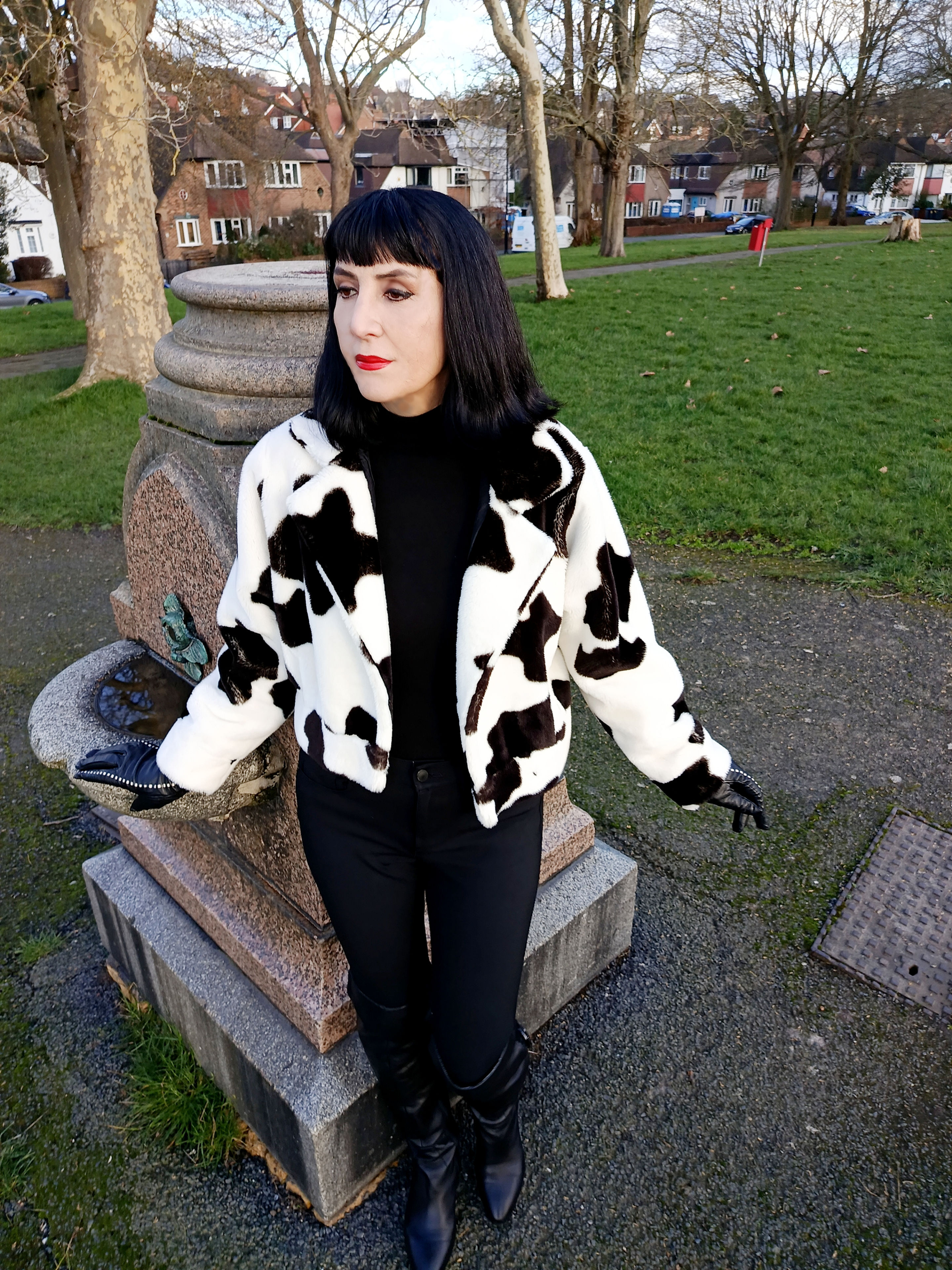

Print, at its most powerful, is never just surface—it is attitude, reference, and reinvention woven into a single gesture. And few patterns have travelled quite as curiously, or as stylishly, as cowprint. And when print is stencilled on faux fur with such panache as done by Apparence, the leaders in it in the 1980s & 90s, it is extra special. So special to find one by them in cowprint, It may be earlier or later, but I suspect it is from the early 1990s when they and cowprint were in their heyday. Yes they are the company of Paris that did the highly collectible Disney print fur coats.
This is a size UK 10 faux fur by Apparence, in immaculate condition no visible staining or discolouration I can see. And that luxuriously soft high thread density faux fur. It comes to the waist, and has a band there. Small lapels. I am a size UK 8 though and would wear, so will fit a smaller size if you like them a little looser fitting, and may fit up to a smallish size 12.
By the early 1990s, fashion had begun to embrace a new kind of visual playfulness. After the polish of the 1980s, there was an appetite for something more graphic, more ironic—something that could flirt with kitsch while remaining undeniably high fashion. Cowprint stepped into that space with quiet confidence: bold, irregular, instantly recognisable, and just subversive enough.
Designers were quick to seize on its potential. Vivienne Westwood, with her instinct for reworking tradition into provocation, understood the print’s ability to destabilise expectations—rural becoming radical, the punk turned pastoral. Meanwhile, Prada approached it with a cooler sensibility, elevating the motif through precision and material, transforming what could have been novelty into something sharply modern.
At the same time, popular culture was reinforcing its presence. In True Romance, Patricia Arquette’s wardrobe—most memorably a cowhide-patterned skirt—captured a kind of offbeat, hyper-feminine rebellion. It wasn’t polished, it wasn’t conventional, but it was unforgettable. The print became shorthand for a certain kind of character: bold, a little wild, and entirely self-defined.
It was within this cultural moment that Apparence Paris carved out its own distinctive space. Known for pushing faux fur beyond imitation into graphic expression, the house embraced pattern with unusual confidence. Their collections—produced around the time of the opening of Disneyland Paris—even played with iconic imagery, translating motifs like Mickey Mouse into richly textured, high-density faux furs. It was a bold proposition: playful, referential, and technically accomplished.
The cowprint jacket sits perfectly within that lineage.
Cut cropped to the waist, it captures the early 1990s silhouette at its most flattering—lifting the frame, defining the body, and allowing the volume of the fur to work in contrast rather than excess. The faux fur itself is remarkable: densely constructed, with a notable cotton content that gives it substance and integrity. This is not novelty fabric—it has weight, presence, and a tactile richness that rivals its natural counterparts.
And then, of course, there is the pattern.
Cowprint, in faux fur, becomes something else entirely. It softens without losing its graphic edge, the irregular black-and-white markings diffused slightly through texture. It is at once bold and wearable, statement-making yet strangely neutral. It refuses to sit quietly. and yet it integrates effortlessly. It had also had its moments in the 1960s 1970s and 1980s, so it keeps coming back and goes with a variety of styles.
What makes it enduring is precisely this duality. The print carries associations—of the pastoral, of Americana, of pop culture—but in the hands of designers and houses like Apparence Paris, those references are reworked into something sharper, more self-aware. It becomes less about origin and more about intention.
And intention is what has brought cowprint back, time and again. In recent years, designers have returned to it with renewed interest, recognising its ability to cut through minimalism with a sense of humour and clarity. It offers impact without heaviness, nostalgia without sentimentality.
The jacket, then, is more than a relic of 1990s fashion. It is part of a longer conversation—about texture, about print, about the way fashion borrows from the familiar and makes it new again. Cropped, graphic, and quietly irreverent, it stands as proof that even the most unexpected patterns can become enduring icons.
After all, style has always had a soft spot for the unexpected—and cowprint, with its perfect imbalance, continues to deliver exactly that.
